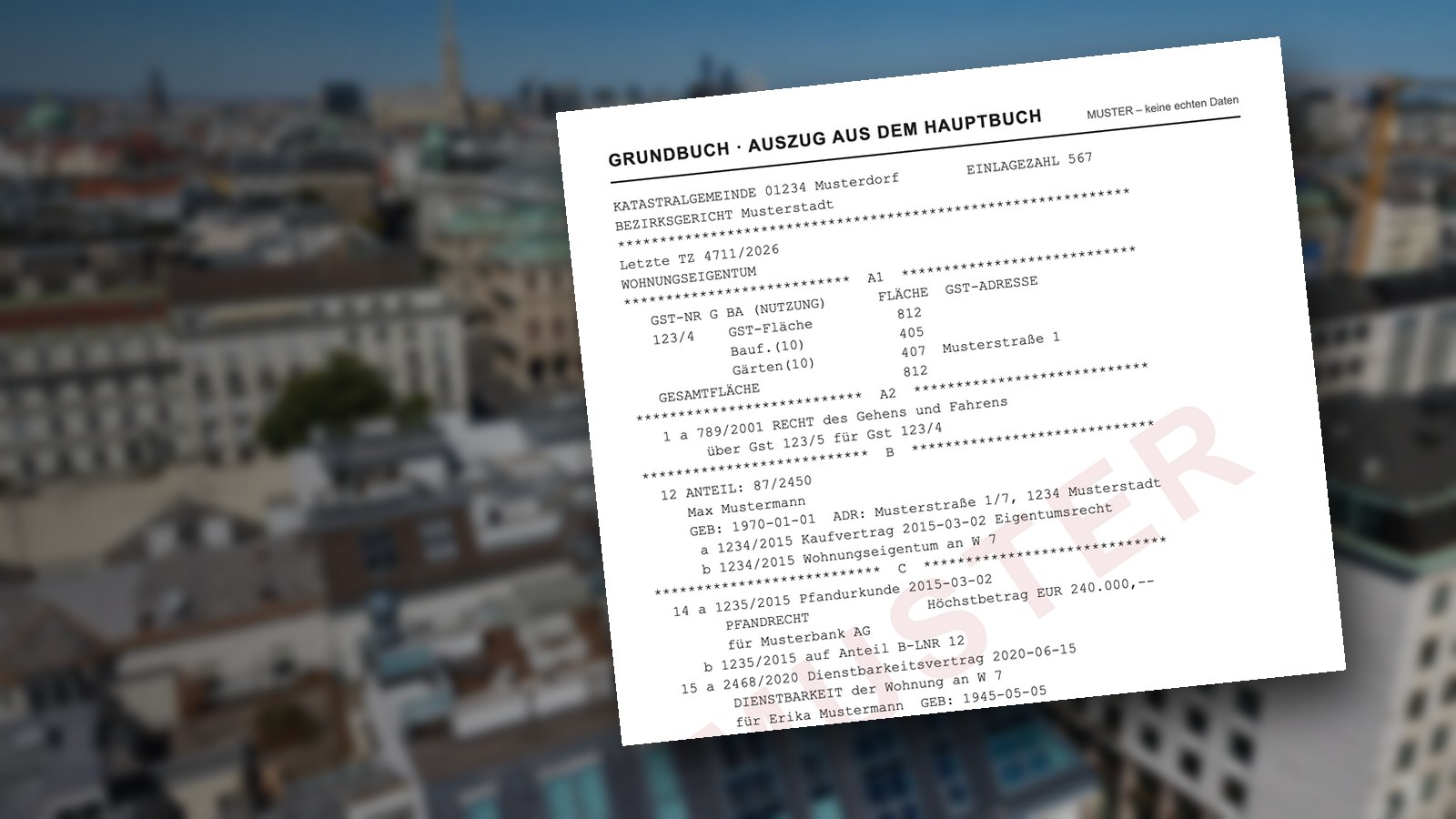
Who owns the apartment, is there still a loan on it, does anyone have a right of residence? It's all in the land register (Grundbuch). You can get an extract yourself in a few minutes. Here's how, what it costs and how to read it.
Online in minutes
Via JustizOnline or an authorized provider.
Free for owners
The extract for your own property costs nothing.
Public
Anyone can look at the land register – including buyers and banks.
Certified
If an authority needs it, get it from a notary.
Getting a land register extract online: how it works
The Austrian Ministry of Justice provides land register and cadastral data via JustizOnline. Authorized providers such as MANZ offer the same access but charge their own fee on top.
- Open the portal: JustizOnline or an authorized provider.
- Find the property: fastest with the cadastral community (KG) and entry number (EZ). Both are in your purchase contract. If you don't know them, use the address search.
- Choose the extract: the full extract with all three sheets, a partial extract with just one sheet, or a historical extract that also shows deleted entries.
- Download and save: the extract shows the status at the time of your search.
Prefer to go in person? You can also get the extract at the district court. A certified copy – for an authority, for example – is issued by a notary.
How much does a land register extract cost?
The fees are set by the Court Fees Act and apply throughout Austria, including Vienna and Lower Austria:
| Search | Fee |
|---|---|
| Current full extract (A, B and C sheets) | €4.89 |
| Partial extract (one sheet) | €2.60 |
| Historical extract, last 5 years | €2.44 |
| Historical extract, no time limit | €5.80 |
| Document from the deed collection, each | €1.52 |
| Seal check (latest file number) | €0.61 |
| Address search, up to 10 results | €1.52 |
| Extract at the district court | €19 |
| Your own property, for owners (JustizOnline) | €0 |
As of October 2026, according to oesterreich.gv.at. Providers charge their own fee on top, which is why you often see higher prices online.
Example: a full extract plus two documents, such as the condominium agreement and the unit value appraisal, cost €7.93 in total.
Free extract for owners: what applies
Since October 1, 2026, owners can get the extract for their own property free of charge via JustizOnline. This doesn't apply via providers or for other people's properties.
For co-ownership – with your partner or as co-heirs, for example – the search is only free under your own name as an owner. Anything beyond that costs the normal court fee.
What's in the extract? The A, B and C sheets explained
Every property has its own entry number. The header of the extract shows the cadastral community, the entry number and the competent district court, followed by three sheets.
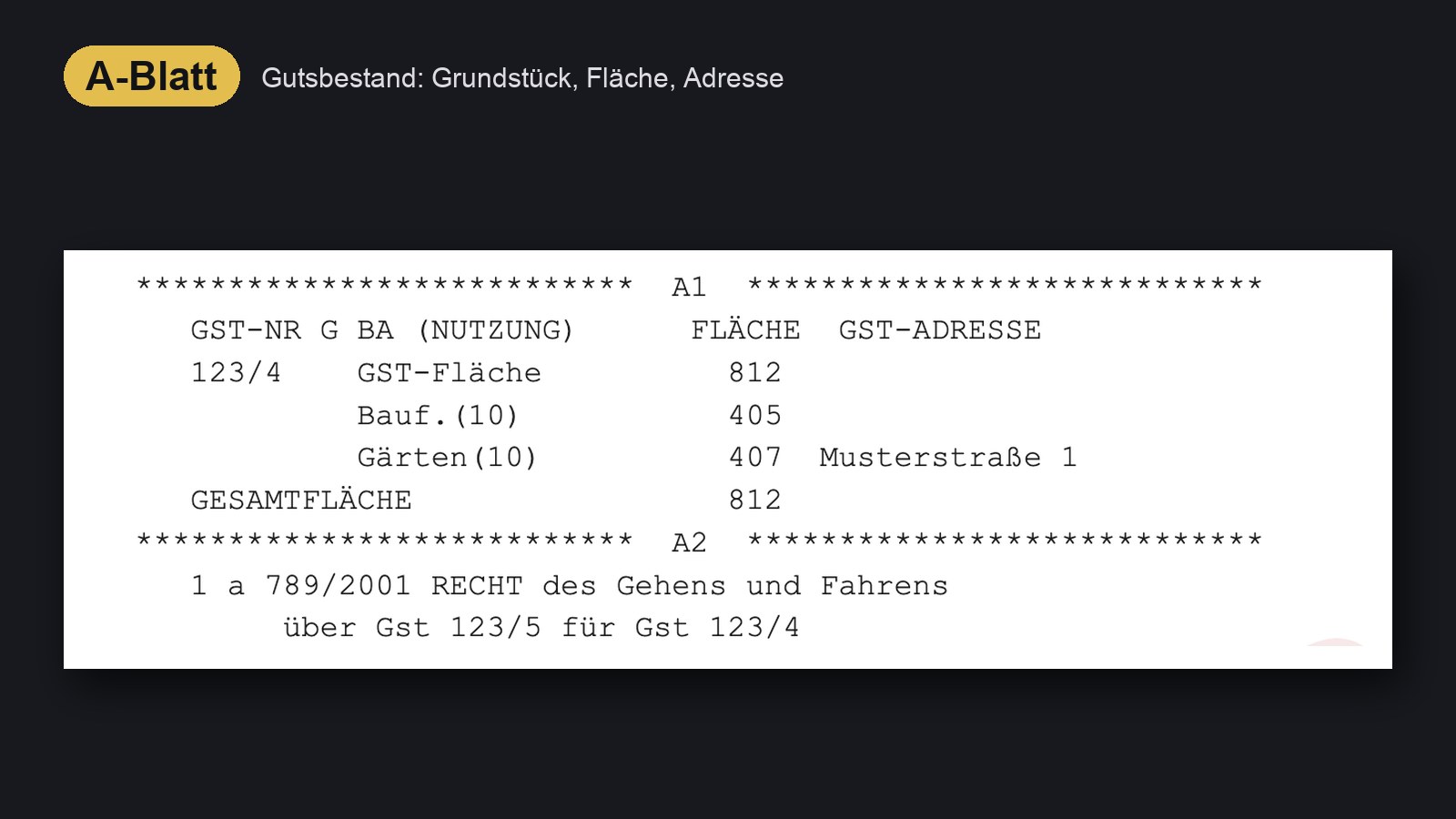
A sheet, the property inventory: part A1 lists the plots with number, use, area and address. Part A2 lists rights attached to the property, such as a right of way across the neighboring plot.
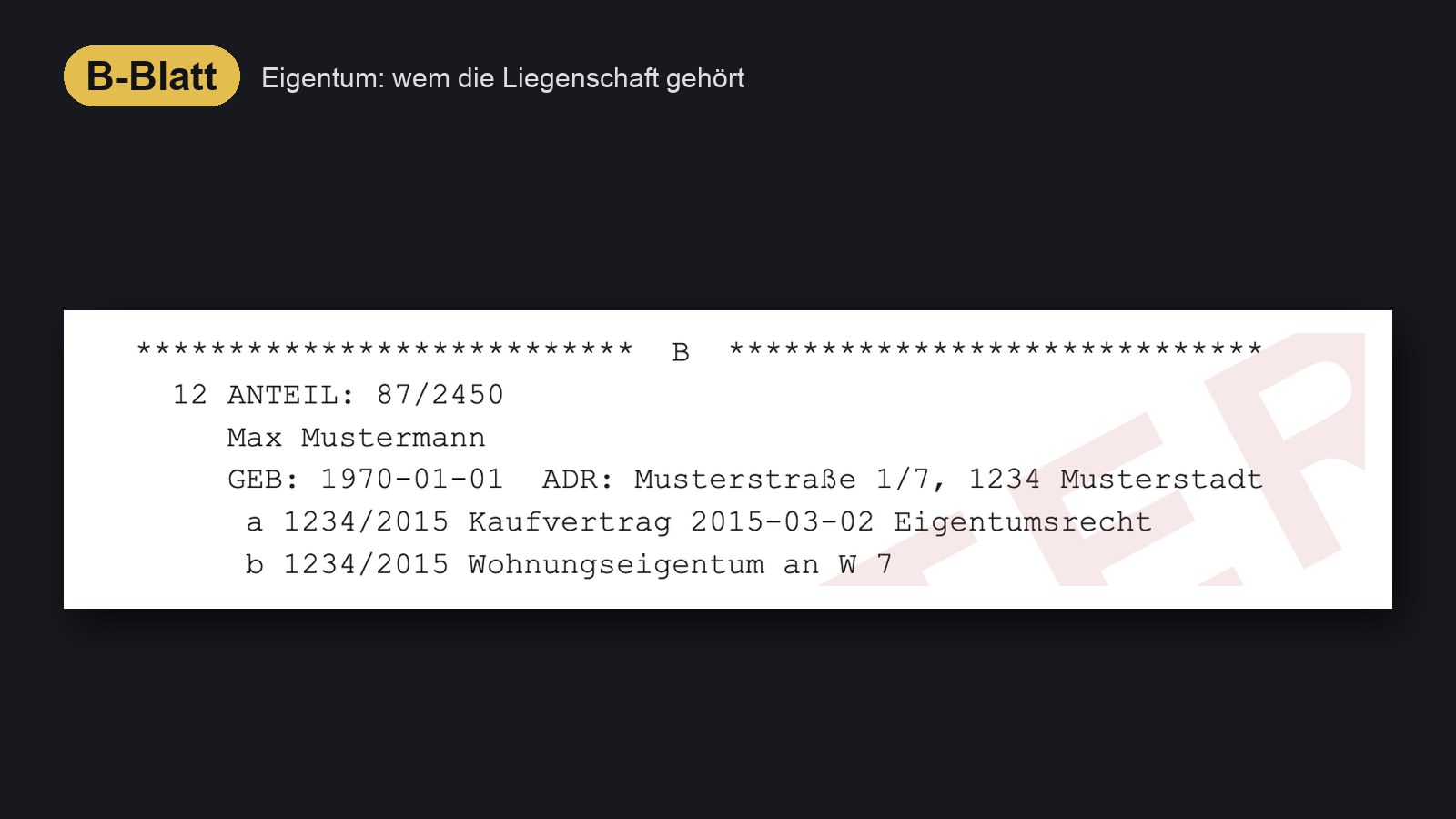
B sheet, ownership: this shows who owns the property: name, date of birth, share and how it was acquired – for example a purchase contract, a gift or a court transfer order after an inheritance. For a condo, the share is a fraction like 87/2450. It comes from the unit value appraisal, together with a note on which apartment the condominium ownership relates to.
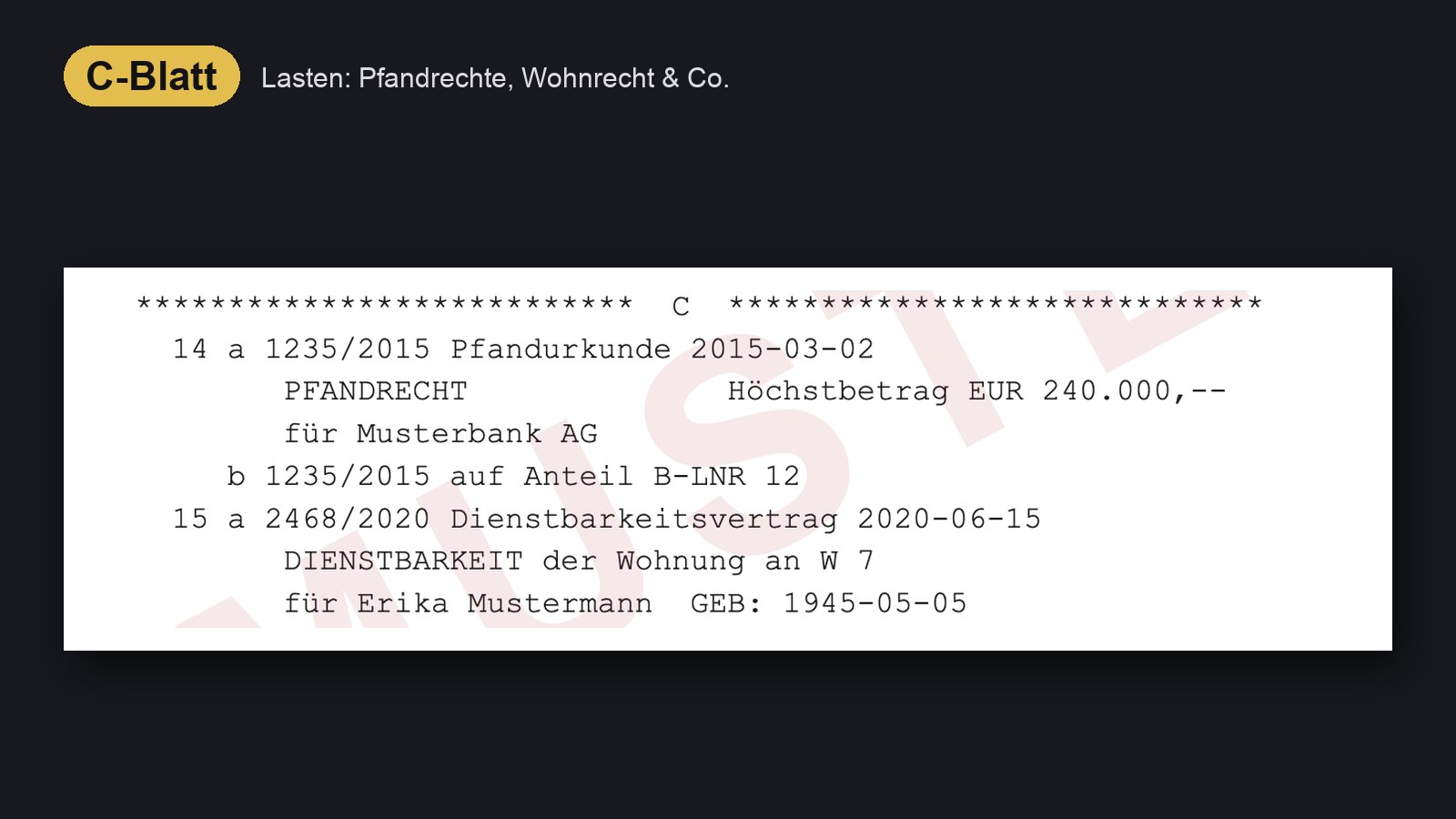
C sheet, encumbrances: mortgages for loans with the maximum amount, easements such as a right of residence, rights of first refusal and bans on encumbrance or sale. When you sell, this is the most important sheet.
Reading the extract: file number, rank and seal
- File number (TZ): every entry carries the number of the application, e.g. 1234/2015. With it, you can find the related document in the deed collection – the purchase contract or the mortgage deed.
- Rank: the order of encumbrances depends on when the application reached the land register court. This matters most when several mortgages are registered.
- Seal (Plombe): shows that an application for this property is currently being processed. The extract isn't fully up to date yet.
The land register extract when selling: what to check
Get the extract before you list. The buyer, bank and notary will look at it anyway – this way, you spot surprises before they do.
- B sheet: are the names and shares correct? After an inheritance or a divorce, that isn't always the case.
- C sheet: if a mortgage is registered, you need the bank's release confirmation to delete it. A right of residence or a right of first refusal is best clarified early with a notary or lawyer.
- Seal: if an application is still pending, find out what it's about.
- Documents: the condominium agreement and the unit value appraisal are in the deed collection and belong in the documents for buyers. What else you need is in our checklist for selling an apartment.
What registering the new owner in the land register costs is explained in our article Land register: the fee exemption for home buyers has ended.
Before selling, take a close look at your C sheet in particular. Otherwise, a right of first refusal or a right of residence may only come up at the notary's office. If an entry is unclear to you, we're happy to look at it with you.