Many people expect a big tax bill when they inherit. In Austria, that tax has not existed since 2008. Still, an inherited or gifted house is not free. Here you will see what you actually pay and what you have to report to the tax office.
No tax since 2008
Inheritance tax (Erbschaftssteuer) and gift tax (Schenkungssteuer) have not been collected since August 1, 2008.
Real estate still costs
For a house, an apartment or a plot of land, you pay real estate transfer tax and the land register fee.
Report gifts
Larger gifts such as cash or securities have to be reported to the tax office within three months.
Nothing passed
A new inheritance tax is being debated. None of the motions in 2026 found a majority.
Is there an inheritance tax or gift tax in Austria?
No. Since August 1, 2008, you pay neither inheritance tax nor gift tax in Austria.
The Constitutional Court (Verfassungsgerichtshof) struck down both taxes in 2007, first the inheritance tax in March, then the gift tax in June. It had nothing against the tax as such. Its problem was that real estate was valued with very old assessed values (Einheitswerte), far below other assets.
Lawmakers had until July 31, 2008 to fix the law. They let the deadline pass. Since then:
- Cash, savings accounts, securities, jewelry, cars: You inherit them without paying inheritance tax. You do not need a tax-free allowance, because the tax does not exist.
- House, apartment, plot of land: No inheritance tax here either. Instead, you pay real estate transfer tax and a fee for the land register.
- Gifts during your lifetime: The same rules apply as for inheritance. For larger gifts, you also have to notify the tax office.

What you still pay for a house or an apartment
Two costs come up almost every time: the real estate transfer tax and the entry in the land register.
- Real estate transfer tax (Grunderwerbsteuer): For inheritances and gifts, a tiered rate applies. You pay 0.5% on the first 250,000 euros, 2% on the next 150,000 euros and 3.5% on anything above that. It is calculated on the property value (Grundstückswert), a value worked out under official rules.
- Land register (Grundbuch): Being registered as the new owner costs 1.1%. Within the family, this fee is not calculated on the full value, but on three times the assessed value (Einheitswert), capped at 30% of the value.
- Proceedings and contract: When you inherit, the costs of the probate proceedings (Verlassenschaftsverfahren) come on top. When you receive a gift, the costs of the contract.
For the land register fee, family includes spouses, children, grandchildren, parents, siblings, nieces and nephews, among others. Unmarried partners count if they share or shared a main residence.
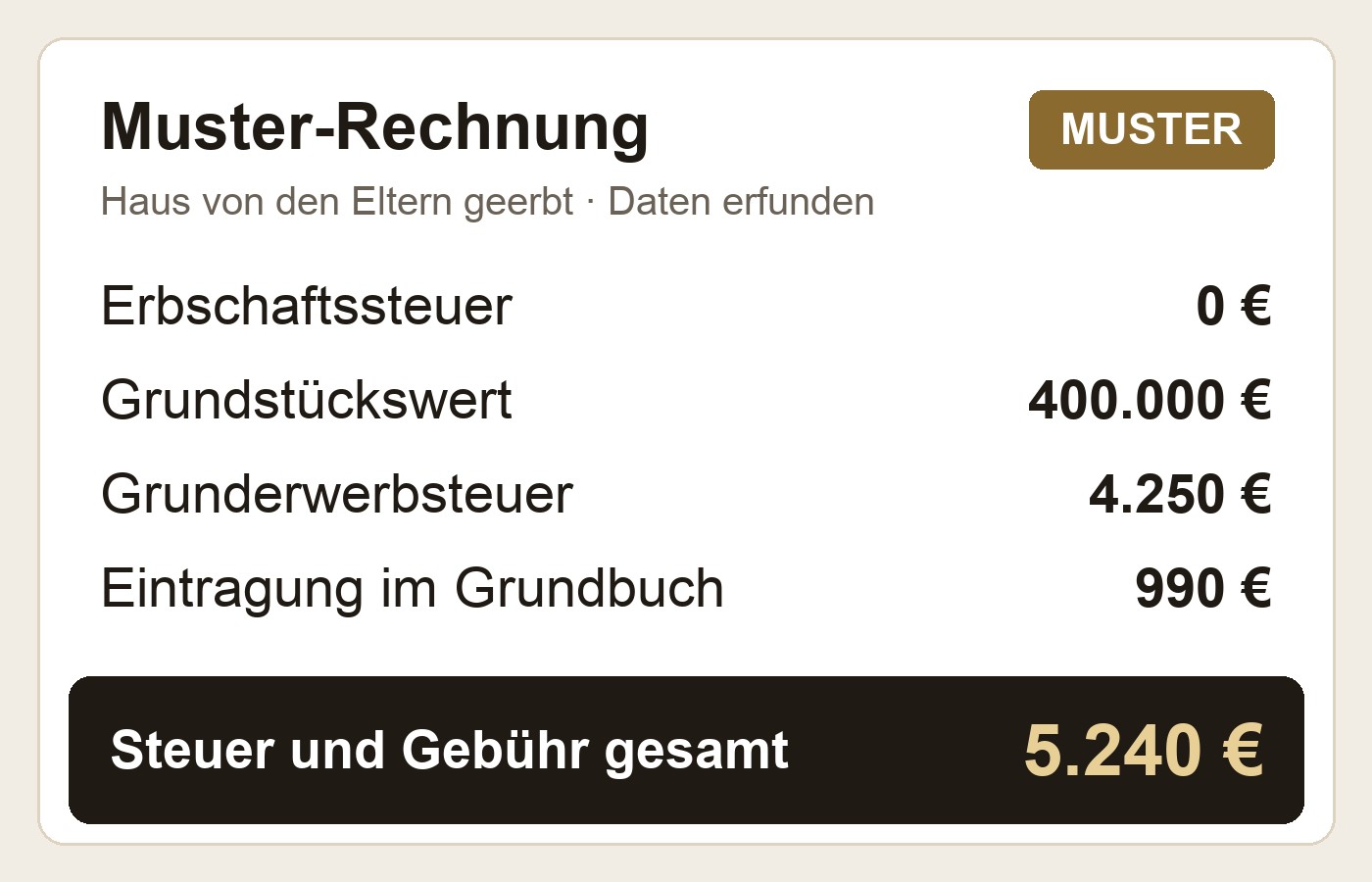
An example: You inherit your parents' house. The property value is 400,000 euros, the assessed value 30,000 euros. The real estate transfer tax comes to 4,250 euros. For the land register you pay 1.1% of 90,000 euros, which is 990 euros. Together that makes 5,240 euros.
How the property value is calculated and which exception applies to spouses is explained in our guide to the real estate transfer tax.
Reporting a gift: when the tax office needs to know
Larger gifts have to be reported. You do not pay any tax on them, it is only about the notification.
- What you report: Cash, savings accounts, securities, shares in companies, businesses and valuable items such as jewelry or a car.
- Threshold between relatives: when gifts from the same person add up to more than 50,000 euros in one year.
- Threshold between non-relatives: when they add up to more than 15,000 euros within five years.
- Deadline: three months from the gift. You report it through FinanzOnline, the tax office's online portal. From January 1, 2027, the law requires the official form in FinanzOnline for this.
- Who reports: Both the giver and the recipient are obliged to report. If one of them reports on time, it is done for both.
You do not have to report customary gifts for occasions such as birthdays or weddings up to 1,000 euros, or household items. You also do not need this notification for a gifted house or apartment. There, everything runs through the real estate transfer tax. Inheritances are exempt as well.
Anyone who deliberately fails to report risks a fine of up to 10% of the value of the gift.

Is inheritance tax coming back? Where things stand in November 2026
Not at the moment. There is no majority for it in the National Council (Nationalrat), and nothing has been passed as of November 21, 2026.
- February 25, 2026: The Greens called for an inheritance and gift tax on inheritances worth millions in an urgent motion. No other party supported it.
- July 10, 2026: Another motion by the Greens was rejected. ÖVP, SPÖ, NEOS and FPÖ voted against it.
- October 21, 2026: A new motion by the Greens was referred to the Finance Committee.
Finance Minister Markus Marterbauer of the SPÖ considers the tax the right thing to do. But he does not expect it to get through before the next election himself. The ÖVP points out that it is not part of the government program. NEOS and FPÖ reject it.
All proposals target very large inheritances of one million euros or more. There is no finished bill with rates and allowances.
What does this mean for you as a seller?
Many inherited houses and apartments are sold. The tax that matters then is the capital gains tax on real estate (Immobilienertragsteuer).
- Land register first: As a rule, you can sell once the probate proceedings are completed and you are registered as the owner. Our guide on selling inherited property shows how it works.
- Tax when you sell: What counts is when and for how much the deceased person or the giver bought the property. More in our guide to the capital gains tax on real estate.
- Older properties: If the property was bought before April 2002, the tax on a sale goes up from 2027.
- Several heirs: You all have to agree. A clear market value helps if one of you wants to buy out the others.


Gift or inheritance: what to sort out first
For the real estate transfer tax it makes no difference. The same tiered rate applies to gifts and inheritances.
- Gifting in parts: If you receive several parts from the same person within five years, they are added together to work out the tax rate.
- Compulsory share (Pflichtteil): Children and spouses are always entitled to half of their statutory share of the estate. Gifts made during the giver's lifetime are taken into account.
- Ownership is gone right away: Whoever gives the house away no longer owns it. That is why many parents have a right of residence (Wohnrecht) registered for themselves.
- Selling later: Registered rights such as a right of residence remain in place and push down the price.
Which solution suits your family is best clarified with a notary or a lawyer before anything is signed.
Have the market value determined before you divide or hand over anything within the family. A clear number makes the conversation easier, whether one of you takes over the house or you sell it together. We value your property free of charge.