Everyone who owns a house, an apartment or a plot of land in Austria pays property tax (Grundsteuer). It is usually small, but it comes every year. Here you can see how it is calculated, who pays it and what applies when you sell.
Goes to the municipality
The tax office sets the basis. The municipality sends you the notice and gets the money.
Old values as the basis
The tax is based on the assessed value (Einheitswert). It reflects the situation in 1973 and is far below market value.
Multiplier of up to 500%
That is the most a municipality may charge. Vienna charges 500%.
Nothing decided
Cities and municipalities are asking for more. So far, no increase has been passed.
What is the Grundsteuer and who gets it?
The Grundsteuer is a yearly tax on owning real estate. All of the money goes to the municipality.
It is governed by the Property Tax Act of 1955 (Grundsteuergesetz 1955). It applies to land with and without buildings, so an empty building plot is taxed too. According to the Ministry of Finance, the property tax on real estate brought in around €755 million in 2022, spread across about 2.5 million properties.
Don't mix the two up: You pay the property transfer tax (Grunderwerbsteuer) once, when you buy. You pay the Grundsteuer every year for as long as you own the property.
How the property tax is calculated
The calculation has three steps: assessed value, base amount, municipal multiplier.
- 1. Assessed value (Einheitswert): This is a value the tax office sets for every property. It is based on conditions as of January 1, 1973, and was raised by a flat 35% in 1983. You will find it in your assessed value notice (Einheitswertbescheid).
- 2. Base amount (Messbetrag): A small part of the assessed value is taken, at most 2‰ (2 per thousand, or 0.2%). Lower rates apply to the first euros.
- 3. Municipal multiplier (Hebesatz): The municipality multiplies the base amount by its multiplier. Up to 500% is allowed, which means five times the base amount.
The reduced rates by type of property:
- Single-family home: 0.5‰ on the first €3,650, 1‰ on the next €7,300, 2‰ on the rest.
- Rental apartment building and mixed-use building: 1‰ on the first €3,650, 1.5‰ on the next €3,650, 2‰ on the rest.
- Everything else, such as a building plot or a commercial building: 1‰ on the first €3,650, 2‰ on the rest.
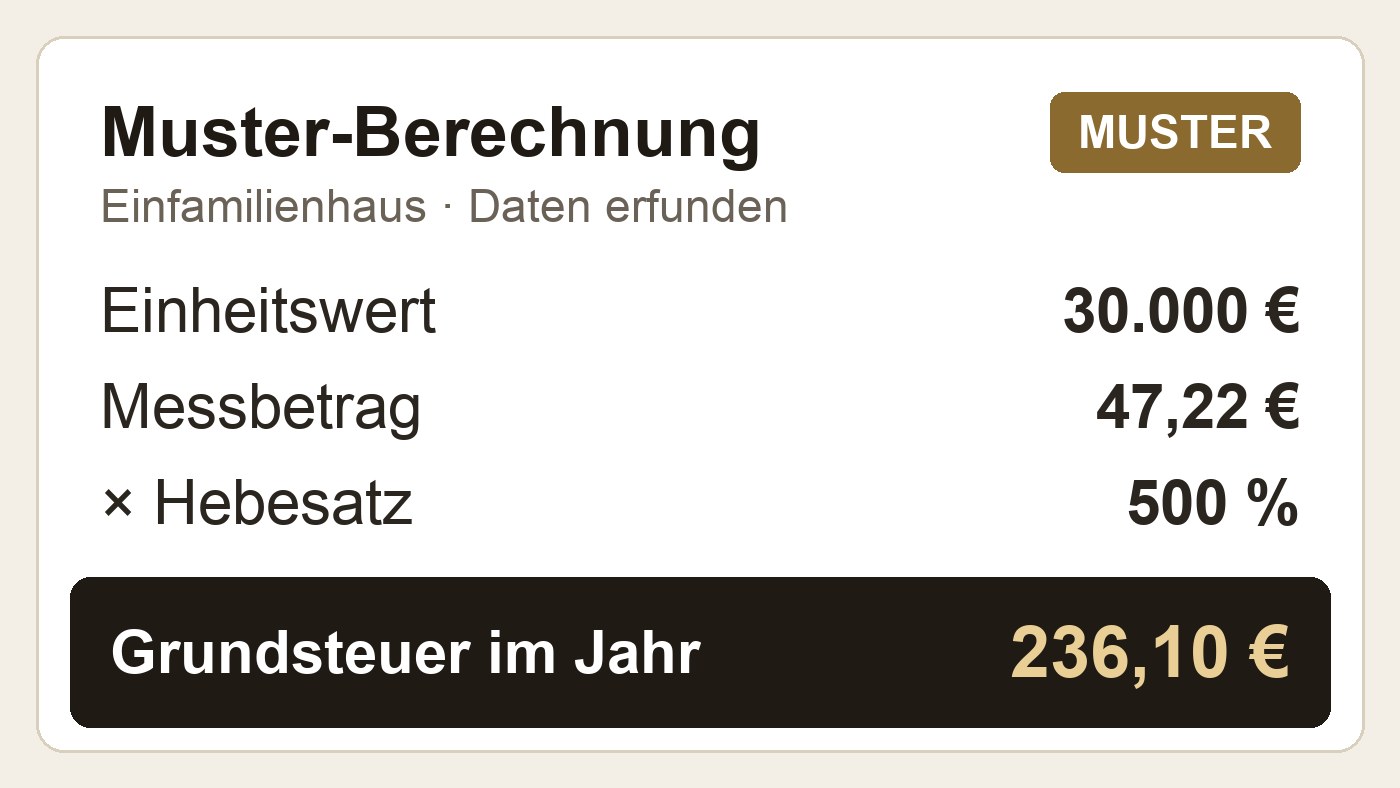
An example: A single-family home has an assessed value of €30,000. The math is €3,650 times 0.5‰, then €7,300 times 1‰, and the remaining €19,050 times 2‰. That gives a base amount of €47.22. With a multiplier of 500%, that comes to €236.10 in property tax per year.
Condominiums are not assessed one by one. The whole building counts as a single unit.
Who pays: owners, tenants and what applies when you sell
The owner owes the tax. If several people own the property, all of them are liable together.
- Owner: You get the notice and pay the municipality. With a building right (Baurecht), the holder of the building right pays.
- Tenant: In tenancies that fall fully under the Tenancy Act (Mietrechtsgesetz), the landlord may pass on the property tax to tenants, in proportion, as part of the operating costs (Betriebskosten). The Supreme Court has confirmed this.
- Buyer: The tax always arises at the start of the year. The tax office only transfers the property to the new owner as of January 1 after the sale.
Who covers which part in the year of the sale is something you and the buyer settle in the purchase contract. Our guide to closing costs shows what other costs come up when buying.
When and how do you pay?
The property tax is due in four equal parts: on February 15, May 15, August 15 and November 15.
- Small amounts: If the tax comes to no more than €75 per year, you pay it all at once on May 15.
- Two notices from the tax office: The assessed value notice and the notice on the base amount come from the Austrian tax office (Finanzamt Österreich).
- One notice from the municipality: It sets the yearly amount and collects it. In Vienna, this is done by the city department MA 6.
- Objections: If you think the assessed value is wrong, you have to challenge the notice from the tax office, not the one from the municipality.
The municipality's notice stays valid until a new one arrives. So you should not expect a new letter every year.
Is an increase coming? Where things stand in November 2026
It has been called for over many years, but nothing has been passed. The maximum multiplier of 500% is unchanged in the law.
- Association of Cities (Städtebund): In its 2026 municipal finance report, it proposes raising the maximum multiplier from 500% to 750%. According to the association, that would bring in €396 million per year.
- Association of Municipalities (Gemeindebund): It has also spoken out repeatedly for a higher property tax, most recently in November 2026.
- Government: In May 2026, Chancellor Stocker said about the budget for 2027 and 2028 that there would be no increase in the property tax.
What would the proposal mean for the example above? At 750% instead of 500%, it would be €354.15 instead of €236.10 per year. This is only a calculation to give you a sense of scale, not a decision.
One thing has already changed in Vienna: The temporary property tax exemption for new buildings has been abolished. Since February 25, 2026, you can no longer file a new application. Exemptions that were already granted continue to run.
What does this mean for you as a seller?
The property tax does not make or break a sale. But unpaid amounts can hold it up.
- Pay what is overdue: The property itself is liable for the property tax through a statutory lien. That is why a buyer wants to be sure nothing is outstanding.
- Have the notices ready: The assessed value notice and the latest property tax notice belong in your folder. What else goes in there is listed in our checklist for selling.
- Put the split in writing: Agree on a cutoff date in the purchase contract from which the buyer covers the running costs.
- The assessed value is not the price: It says nothing about what your property is worth today.
When you sell, a different tax usually weighs much more heavily: the real estate capital gains tax (Immobilienertragsteuer).
Dig out your assessed value notice before you sell, and ask the municipality whether everything has been paid. That saves you follow-up questions shortly before signing. What your property is really worth on the market has nothing to do with the assessed value. Get a free valuation from us.